For decades, GHK-Cu has been primarily associated with skin science.
Known for its role in processes related to the extracellular matrix, collagen, tissue remodeling, and regeneration, the complex formed by the GHK tripeptide and copper has become a molecule of interest in dermatological research.
But new research suggests that the story may be much broader.
In May 2026, researchers from Yunnan University and Kunming Medical University published a study in Biogerontology investigating GHK-Cu from a different perspective: longevity, mitochondrial function, and cellular responses to aging.
Using Caenorhabditis elegans as an experimental model, the researchers observed that GHK-Cu extended lifespan and improved several markers associated with aging.
Even more interestingly, the findings pointed toward a mechanism involving mitochondria and two important cellular stress-response pathways: DAF-16 and SKN-1.
From Skin Science to the Biology of Aging
GHK — glycyl-L-histidyl-L-lysine — is a small tripeptide naturally present in the human body that can form a complex with copper.
Research on GHK-Cu has explored a range of biological processes, particularly those related to skin and connective tissue.
The new study expands this perspective.
Instead of looking exclusively at local effects, the researchers investigated whether GHK-Cu could influence mechanisms associated with systemic aging in an experimental organism.
The results were notable: GHK-Cu increased the lifespan of C. elegans and improved several parameters associated with health during aging, including mobility, resistance to oxidative and thermal stress, pharyngeal activity, and age-related changes in lipofuscin and lipid accumulation.
But perhaps the most interesting findings were taking place inside the cell.
Mitochondria at the Center of the Investigation
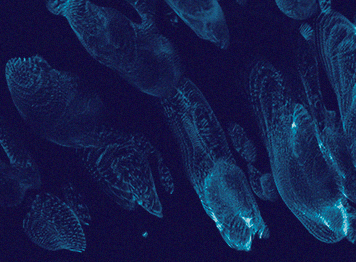
Mitochondria are much more than cellular structures responsible for energy production.
They participate in cellular signaling, metabolism, stress responses, and the maintenance of cellular homeostasis. With aging, alterations in mitochondrial function and dynamics may contribute to a progressive decline in cellular adaptability.
In the study, GHK-Cu was associated with the preservation of mitochondrial membrane potential.
This potential is essential for efficient energy production and proper function of the mitochondrial respiratory chain.
Animals treated with GHK-Cu also showed increased ATP production — ATP being the primary energy currency of the cell — compared with untreated animals.
This places mitochondria at the center of the mechanism proposed by the study.
Fission and Fusion: Why Mitochondrial Shape Matters
Mitochondria are not static structures.
They continuously divide and merge through processes known as fission and fusion.
This balance allows the mitochondrial network to adapt to the changing demands of the cell.
In the study, GHK-Cu shifted this balance toward fusion.
Researchers observed reduced expression of drp-1, which is associated with mitochondrial fission, alongside increased expression of fzo-1, which is involved in mitochondrial fusion.
The result was reduced fragmentation of the mitochondrial network associated with aging and a greater tendency toward the formation of interconnected mitochondrial networks.
In other words, the study suggests that GHK-Cu may influence not only how much energy mitochondria produce, but also how the mitochondrial network organizes and adapts.
Less Oxidative Stress, Stronger Cellular Defense
Another important component of aging is the balance between the production of reactive species and the cell’s ability to neutralize them.
In the study, GHK-Cu was associated with reduced markers of oxidative stress and activation of endogenous cellular defense mechanisms.
Among the genes showing increased expression were sod-3, gst-4, and gcs-1, which participate in different mechanisms involved in cellular protection against oxidative stress.
This is particularly interesting because the observed effect does not appear to be simply a matter of supplying an external antioxidant.
The mechanism proposed by the researchers involves the activation of endogenous cellular defense programs.
And this is where DAF-16 and SKN-1 become particularly relevant.
DAF-16 and SKN-1: Regulators of the Cellular Stress Response
In C. elegans, DAF-16 and SKN-1 are central transcription factors involved in regulating responses related to stress, metabolism, and longevity.
DAF-16 performs functions comparable to those of the FOXO family in mammals, while SKN-1 is associated with antioxidant signaling related to NRF2.
When activated, these factors can regulate the expression of multiple genes involved in cellular protection and adaptation.
In the study, GHK-Cu increased the activity of these pathways, accompanied by increased expression of genes involved in cellular defense.
This helps explain why the observed effect does not appear to depend on a single mechanism.
Instead, the molecule appears to influence an interconnected network of processes: mitochondrial function, mitochondrial dynamics, energy production, and cellular stress responses.
GHK-Cu: More Than an Antioxidant
Perhaps this is one of the study’s most important messages.
Describing GHK-Cu simply as an antioxidant would reduce the complexity of the mechanism being investigated.
The findings suggest a coordinated interaction involving:
Mitochondrial function → mitochondrial dynamics → ATP production → antioxidant response → longevity signaling.
This perspective is particularly relevant to longevity science, which increasingly views aging not as the result of a single process, but as a network of interconnected cellular changes.
And mitochondria sit at the center of that network.
A Promising Finding — Still Experimental
It is important to establish the limits of what this study demonstrates.
The experiments were conducted in Caenorhabditis elegans, a model organism widely used in aging and longevity research.
The results show that GHK-Cu extended lifespan in these animals and improved several markers associated with aging.
This does not mean that the same effect has been demonstrated in humans.
Further studies in additional experimental models — and, ultimately, well-designed clinical research — are needed to determine whether these mechanisms can be reproduced in humans and what their biological significance may be.
The study should therefore be interpreted as experimental evidence of a potential geroprotective mechanism, rather than evidence that GHK-Cu extends human lifespan.
A New Way to Look at GHK-Cu
Perhaps the most interesting aspect of these findings is not simply the increase in lifespan observed in the experimental model.
It is the change in perspective.
GHK-Cu, historically associated with skin biology, is now being investigated within a much broader biological framework: mitochondria, metabolism, oxidative stress, cellular signaling, and aging.
This transition — from localized applications toward a systemic understanding — reflects a broader evolution in longevity science itself.
Researchers are increasingly looking beyond how a molecule affects a specific tissue and toward how it interacts with the biological systems that maintain cellular function over time.
The Next Step Is in the Questions
The 2026 study opens the door to a new set of questions.
If GHK-Cu influences mitochondrial dynamics in C. elegans, does the same mechanism occur in mammals?
Is preservation of mitochondrial membrane potential a central component of the observed effect?
How do DAF-16 and SKN-1 interact with other longevity regulators?
And, most importantly, to what extent can these mechanisms be translated to human biology?
We do not have all the answers yet.
But this is precisely how science moves forward.
A molecule known for decades for its relationship with skin is investigated from a new perspective. A new function is observed. A mechanism begins to emerge. And new questions follow.
GHK-Cu may be more than a molecule associated with skin regeneration.
The latest research places this peptide within a much broader conversation: understanding how cellular function, mitochondrial efficiency, and the body’s capacity to adapt can be preserved over time.
THERA Genetics
Science that delivers.
Applied excellence that transforms possibilities into reality.
Informational and educational content. It does not constitute medical advice, diagnosis, or prescription. The use of any substance or intervention should be evaluated by a qualified healthcare professional, taking into account the individual context and the available scientific evidence.
GHK-Cu, Longevidade e Mitocôndrias: Muito Além da Pele
Durante décadas, o GHK-Cu esteve associado principalmente à ciência da pele.
Conhecido por seu papel em processos relacionados à matriz extracelular, colágeno, remodelamento tecidual e regeneração, o complexo formado pelo tripeptídeo GHK e pelo cobre tornou-se uma molécula de interesse na pesquisa dermatológica.
Mas uma nova publicação sugere que a história pode ser muito maior.
Em maio de 2026, pesquisadores da Yunnan University e da Kunming Medical University publicaram na revista Biogerontology um estudo investigando o GHK-Cu sob uma perspectiva diferente: longevidade, função mitocondrial e resposta celular ao envelhecimento.
Utilizando Caenorhabditis elegans como modelo experimental, os pesquisadores observaram que o GHK-Cu prolongou a vida dos animais e melhorou diversos marcadores associados ao envelhecimento.
Mais interessante ainda: os resultados apontaram para um mecanismo que envolve diretamente as mitocôndrias e duas importantes vias de resposta ao estresse celular, DAF-16 e SKN-1.
Do cuidado com a pele à biologia do envelhecimento
O GHK — glicil-L-histidil-L-lisina — é um pequeno tripeptídeo naturalmente presente no organismo e capaz de formar um complexo com o cobre.
A pesquisa sobre GHK-Cu já explorou diferentes processos biológicos, especialmente aqueles relacionados à pele e ao tecido conjuntivo.
O novo estudo amplia essa perspectiva.
Em vez de observar apenas efeitos locais, os pesquisadores investigaram se o GHK-Cu poderia influenciar mecanismos associados ao envelhecimento sistêmico em um organismo-modelo.
E a resposta observada foi relevante: o tratamento com GHK-Cu aumentou a longevidade de C. elegans e melhorou diferentes parâmetros relacionados à saúde durante o envelhecimento, incluindo mobilidade, resistência ao estresse oxidativo e térmico, atividade faríngea e alterações associadas ao acúmulo de lipofuscina e lipídios.
Mas o resultado mais interessante talvez esteja dentro da célula.
A mitocôndria no centro da investigação
As mitocôndrias são muito mais do que estruturas responsáveis pela produção de energia.
Elas participam da sinalização celular, metabolismo, resposta ao estresse e manutenção da homeostase. Com o envelhecimento, alterações na função e na dinâmica mitocondrial podem contribuir para a perda progressiva da capacidade de adaptação celular.
No estudo, o GHK-Cu foi associado à preservação do potencial de membrana mitocondrial.
Esse potencial é essencial para a produção eficiente de energia e para o funcionamento adequado da cadeia respiratória.
Os animais tratados com GHK-Cu apresentaram também maior produção de ATP — a principal moeda energética das células — em comparação aos animais não tratados.
Isso coloca a mitocôndria no centro da hipótese de ação do GHK-Cu observada nesse modelo.
Fissão e fusão: quando a forma da mitocôndria importa
As mitocôndrias não permanecem estáticas.
Elas estão constantemente se dividindo e se unindo por meio de processos conhecidos como fissão e fusão mitocondrial.
Esse equilíbrio permite que a rede mitocondrial se adapte às necessidades da célula.
No estudo, o tratamento com GHK-Cu alterou esse equilíbrio em direção à fusão.
Os pesquisadores observaram redução na expressão de drp-1, associado ao processo de fissão, e aumento de fzo-1, relacionado à fusão mitocondrial.
O resultado foi uma redução da fragmentação da rede mitocondrial associada ao envelhecimento e uma organização mais favorável à formação de redes mitocondriais integradas.
Em outras palavras, o estudo sugere que o GHK-Cu não atuou apenas sobre a quantidade de energia produzida pela mitocôndria, mas também sobre a forma como a rede mitocondrial se organiza e se adapta.
Menos estresse oxidativo, Mais defesa celular
Outro componente importante do envelhecimento é o equilíbrio entre produção de espécies reativas e capacidade antioxidante.
No estudo, o GHK-Cu foi associado a uma redução de marcadores relacionados ao estresse oxidativo e à ativação de mecanismos endógenos de defesa.
Entre os genes que apresentaram aumento de expressão estavam sod-3, gst-4 e gcs-1, envolvidos em diferentes mecanismos de proteção celular contra o estresse oxidativo.
Isso é particularmente interessante porque o efeito observado não parece se resumir a simplesmente fornecer uma substância antioxidante.
A hipótese apresentada pelos pesquisadores envolve a ativação de programas celulares de defesa.
E é aí que entram DAF-16 e SKN-1.
DAF-16 e SKN-1: os reguladores da resposta ao estresse
No modelo C. elegans, DAF-16 e SKN-1 são fatores de transcrição centrais na regulação de respostas relacionadas ao estresse, metabolismo e longevidade.
DAF-16 possui funções comparáveis às desempenhadas pela família FOXO em mamíferos, enquanto SKN-1 está relacionado ao eixo antioxidante associado ao NRF2.
Quando ativados, esses fatores podem regular a expressão de diversos genes envolvidos na proteção e adaptação celular.
No estudo, o GHK-Cu aumentou a atividade dessas vias, acompanhada pela expressão de genes relacionados à defesa celular.
Isso ajuda a explicar por que o efeito observado não parece depender de um único mecanismo.
A molécula parece atuar sobre uma rede de processos interconectados: função mitocondrial, dinâmica da rede, produção energética e resposta ao estresse.
GHK-Cu: mais do que um antioxidante
Talvez essa seja uma das principais mensagens do estudo.
Descrever o GHK-Cu simplesmente como um antioxidante seria reduzir a complexidade do mecanismo observado.
O trabalho sugere uma ação coordenada envolvendo:
Função mitocondrial → dinâmica mitocondrial → produção de ATP → resposta antioxidante → sinalização de longevidade.
Essa visão é particularmente relevante para a ciência da longevidade, que vem deixando de analisar o envelhecimento como consequência de um único processo.
Envelhecer envolve uma rede de alterações celulares que se influenciam mutuamente.
E as mitocôndrias estão no centro dessa rede.
Um resultado promissor — mas ainda experimental
É importante estabelecer o limite do que esse estudo demonstra.
Os experimentos foram realizados em Caenorhabditis elegans, um organismo amplamente utilizado em pesquisas sobre envelhecimento e longevidade.
Os resultados mostram que o GHK-Cu prolongou a vida desses animais e melhorou diferentes marcadores relacionados ao envelhecimento.
Isso não significa que o mesmo efeito esteja comprovado em seres humanos.
Ainda são necessários estudos em outros modelos experimentais e, principalmente, pesquisas clínicas para determinar se os mecanismos observados podem ser reproduzidos em humanos e qual seria sua relevância biológica.
Portanto, o estudo deve ser interpretado como evidência experimental de um potencial mecanismo geroprotetor, e não como demonstração de um efeito de extensão da longevidade humana.
Uma nova maneira de olhar para o GHK-Cu
O mais interessante nessa descoberta talvez não seja apenas o aumento da longevidade observado no modelo experimental.
É a mudança de perspectiva.
O GHK-Cu, historicamente associado à pele, começa a ser investigado dentro de uma estrutura biológica muito mais ampla: mitocôndrias, metabolismo, estresse oxidativo, sinalização celular e envelhecimento.
Essa transição — da aplicação localizada para a compreensão sistêmica — acompanha uma transformação maior na própria ciência da longevidade.
Hoje, pesquisadores procuram entender não apenas como uma molécula atua sobre determinado tecido, mas como ela pode interagir com os sistemas que sustentam a função celular ao longo do tempo.
O próximo passo está nas perguntas
O estudo de 2026 abre uma série de novas questões.
Se o GHK-Cu influencia a dinâmica mitocondrial em C. elegans, esse mecanismo também ocorre em mamíferos?
A preservação do potencial de membrana mitocondrial é parte central do efeito observado?
Como DAF-16 e SKN-1 se relacionam com outros reguladores de longevidade?
E, principalmente, até que ponto esses mecanismos podem ser traduzidos para a biologia humana?
Ainda não temos todas as respostas.
Mas é justamente assim que a ciência avança.
Uma molécula conhecida por décadas por sua relação com a pele passa a ser investigada sob uma nova perspectiva. Uma nova função é observada. Um mecanismo é identificado. E novas perguntas surgem.
GHK-Cu pode ser mais do que uma molécula associada à regeneração da pele.
A pesquisa mais recente coloca o peptídeo dentro de uma conversa muito maior: a busca por compreender como preservar a função celular, a eficiência mitocondrial e a capacidade de adaptação do organismo ao longo do tempo.
THERA Genetics
Ciência que entrega.
Excelência aplicada que transforma possibilidades em realidade.
Conteúdo informativo e educacional. Não constitui recomendação médica, diagnóstico ou prescrição. A utilização de qualquer substância ou intervenção deve ser avaliada por um profissional de saúde habilitado, considerando o contexto individual e as evidências científicas disponíveis.